
Parental Alienation and Narcissistic Abuse: A Trauma-Informed Perspective
A trauma-informed exploration of parental alienation in the context of narcissistic abuse, focusing on nervous system impact, relational rupture, and healing without blame or diagnosis.
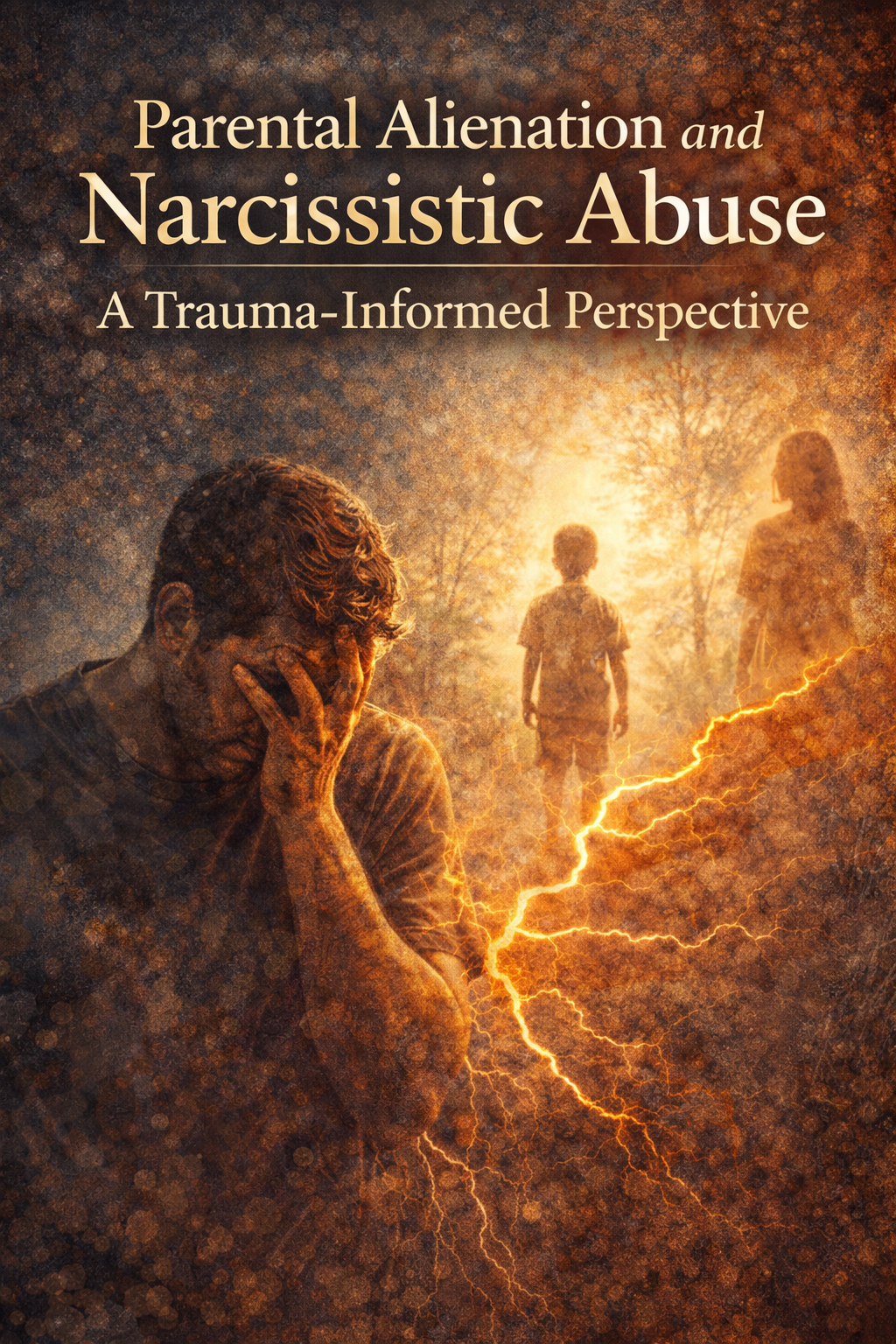
Parental alienation is one of the most painful and least understood experiences a parent can endure.
When it occurs in the context of narcissistic abuse or high-conflict relational dynamics, the impact can be profound. Not only does it disrupt the relationship between parent and child, it destabilises identity, meaning, and a basic sense of continuity in life.
This article reflects my lived experience and professional understanding rather than a clinical diagnosis, legal determination, or definitive account of another person’s psychology.
My intention is not to prove wrongdoing, but to offer a trauma-informed lens on how parental alienation affects the nervous system, relationships, and the healing process.
What is meant by parental alienation
The term parental alienation is used in different ways across legal, clinical, and public discourse. It is also contested, which makes it difficult to speak about safely.
In this context, I am using the term descriptively rather than diagnostically.
Parental alienation refers to situations where a child becomes psychologically distanced from one parent due to ongoing relational dynamics, narratives, or pressures that undermine trust, safety, or attachment.
This distancing is rarely sudden. It often unfolds gradually, through:
Polarised narratives of “good” and “bad”
Subtle erosion of trust
Repeated framing of one parent as unsafe or unreliable
Conflicts the child cannot resolve
From a trauma-informed perspective, what matters most is impact, not intent.
Why parental alienation is uniquely traumatic
Parental alienation differs from many other forms of loss.
There is no clear ending.
There is no socially recognised grieving process.
There is often no reliable framework for repair.
The parent is alive.
The child is alive.
The relationship exists in absence.
This creates a form of ambiguous loss, which is particularly destabilising for the nervous system.
The body remains oriented toward connection that cannot be completed.
The nervous system impact of relational rupture
When a parent loses access to their child under conditions of conflict, the nervous system often enters prolonged survival states.
Common responses include:
Persistent fight-or-flight activation
Collapse, shutdown, or depressive symptoms
Intrusive rumination
Hypervigilance around communication or legal processes
Difficulty focusing, resting, or feeling future-oriented
These responses are not signs of pathology. They are adaptive responses to unresolved threat and loss.
From a nervous system perspective, parental alienation represents:
Loss of attachment
Loss of role
Loss of meaning
Loss of predictability
All at once.
When narcissistic dynamics are present
In some cases, parental alienation occurs within broader patterns often described as narcissistic abuse or high-conflict relational dynamics.
These patterns may include:
Polarisation and splitting
Control through narrative rather than direct force
Inconsistent rules or expectations
A strong need to be right or in charge
Limited capacity for relational repair
I share this not to label or diagnose, but to describe relational environments that make alienation more likely and more difficult to resolve through goodwill alone.
In such environments, logic, negotiation, and reason often fail.
Not because the parent is inadequate, but because the relational system does not reward cooperation.
Splitting and the erosion of complexity
One of the most destabilising dynamics in parental alienation is splitting.
Splitting reduces complex relational realities into binary categories:
Safe or unsafe
Good or bad
Loyal or disloyal
Children caught in these dynamics are often under pressure to resolve emotional conflict by choosing sides.
From a trauma-informed lens, this is not a failure of the child. It is a survival strategy.
Complexity is intolerable in unsafe systems. Simplicity feels safer.
The impact on identity and meaning
For many parents, alienation is not only relational. It is existential.
Parenthood often provides:
Structure
Purpose
Temporal continuity
A sense of contribution beyond the self
When access to a child is disrupted, these foundations are shaken.
This can lead to:
Identity confusion
Shame and self-doubt
Withdrawal from social contact
Difficulty imagining the future
Healing requires addressing not only grief, but identity reorganisation.
Why self-blame is common
One of the most insidious effects of parental alienation is self-blame.
Parents often ask:
“What did I do wrong?”
“If I had been better, would this have happened?”
“Why couldn’t I prevent this?”
From a trauma perspective, self-blame often emerges because it preserves a sense of control.
If the loss was caused by personal failure, then safety might be restored through self-correction.
The problem is that in high-conflict systems, this belief is rarely accurate.
Letting go of self-blame does not mean avoiding responsibility. It means recognising the limits of influence.
Healing without collapsing into bitterness
One of the greatest challenges in parental alienation is healing without hardening.
Bitterness, while understandable, often intensifies suffering by keeping the nervous system locked in threat.
Trauma-informed healing does not require forgiveness or reconciliation. It requires:
Regulation
Boundaries
Meaning-making
Supportive relationships
For me, healing involved learning how to live with grief without allowing it to define my identity.
The role of boundaries and external structure
In high-conflict situations, boundaries are essential.
These boundaries may include:
Limiting exposure to destabilising communication
Seeking professional support
Relying on external structures rather than personal negotiation
Protecting one’s nervous system from constant re-activation
Boundaries are not punishments. They are stabilising measures.
They create the conditions under which healing becomes possible.
Grief that has no timetable
Parental alienation does not follow a predictable healing arc.
There may be:
Periods of relative stability
Sudden re-activation around holidays or milestones
Hope followed by disappointment
Long stretches of uncertainty
Trauma-informed care respects this non-linear process.
Healing is not about “moving on.”
It is about learning to live meaningfully alongside unresolved loss.
Reclaiming agency where possible
One of the most important shifts in my own healing was redirecting energy away from what I could not control and toward what I could.
This included:
Nervous system regulation
Therapy and somatic work
Clarifying values
Investing in supportive relationships
Continuing to live a life aligned with meaning
Agency does not erase grief. It prevents grief from consuming everything else.
A final reflection
Parental alienation is not only a family issue. It is a trauma issue.
It affects the body, identity, and capacity to trust life itself.
A trauma-informed perspective does not seek to assign blame or force resolution. It seeks to restore dignity, capacity, and coherence in the face of profound loss.
If you are navigating parental alienation, there is nothing weak or pathological about your response.
Your system is responding to something deeply human.
Healing is possible, even when resolution is not.
An invitation to work together
I work with individuals navigating complex relational trauma, including parental alienation, using trauma-informed, nervous-system-aware approaches.
If this perspective resonates and you would like support, you can learn more or book a session via the link below.