
Internal Family Systems for Narcissistic Abuse Recovery
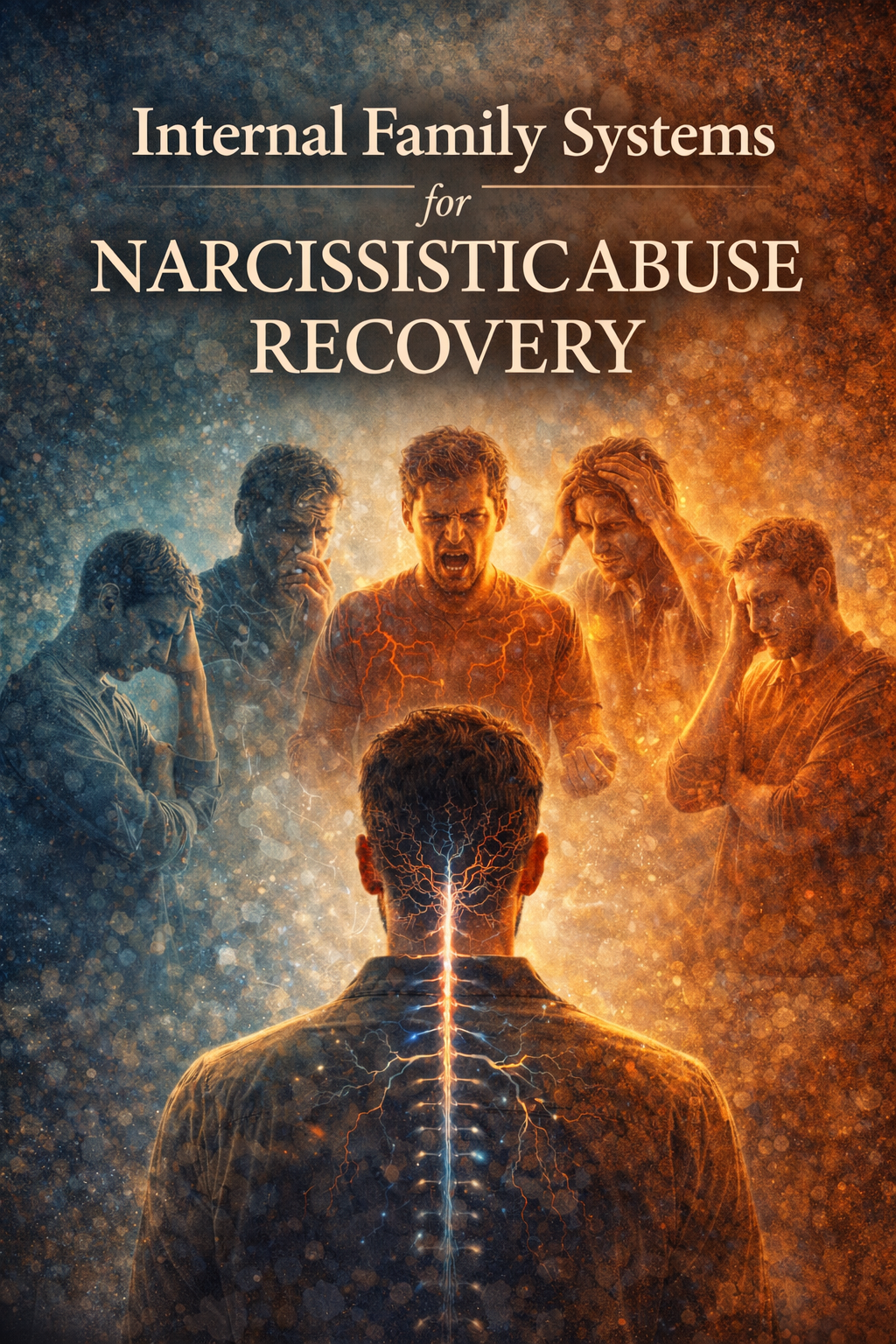
Learn how Internal Family Systems (IFS) therapy supports recovery from narcissistic abuse by working with protective parts, shame, over-functioning, and rebuilding internal leadership.
One of the most disorienting effects of narcissistic abuse is how fractured the internal world can feel afterward. Even when the relationship ends, the internal conflict often continues.
Part of you knows what happened.
Another part doubts it.
Another feels ashamed for staying.
Another wants to explain, fix, or prove something.
Another just wants the pain to stop.
For a long time, I tried to resolve this conflict by choosing the “right” narrative. That approach did not work.
What helped was learning to relate to my inner experience differently. Internal Family Systems (IFS) provided a framework that made sense of the internal fragmentation without pathologising it.
What follows reflects my lived experience and professional understanding rather than a clinical diagnosis or a definitive account of another person’s psychology.
Why narcissistic abuse creates internal conflict
Narcissistic abuse often involves prolonged exposure to mixed messages. Care and withdrawal. Validation and devaluation. Intimacy and threat.
Externally, this creates confusion. Internally, it creates polarisation.
Different parts of the psyche take on roles to help the system survive:
One part tries to maintain connection at all costs
Another becomes hypervigilant and suspicious
Another minimises or rationalises harm
Another carries shame, grief, or despair
These parts are not signs of dysfunction. They are adaptive responses to an environment that required constant adjustment.
Internal Family Systems helped me understand that I was not broken. I was organised around survival.
A brief orientation to Internal Family Systems
Internal Family Systems was developed by Richard Schwartz. The model is based on the idea that the psyche is made up of parts, each with its own role, history, and intention.
IFS distinguishes between:
Parts, which take on protective or burdened roles
Self, an innate capacity for clarity, compassion, and leadership
The goal of IFS is not to eliminate parts, but to restore Self-leadership so that parts no longer have to operate in extreme or exhausting ways.
This was a critical reframe for me.
Protective parts in narcissistic abuse recovery
In the aftermath of narcissistic abuse, certain protective parts often become dominant.
The appeasing part
This part learned that safety came from accommodation. It explains, soothes, and anticipates the needs of others.
In my case, this part drove over-sharing. I shared too much not because I lacked boundaries, but because this part was trying to relieve pain and restore connection.
Understanding this shifted my self-judgement. What I had called weak boundaries were often protective strategies that had outlived their usefulness.
The self-doubting part
Another common part constantly questions perception and memory.
This part formed in response to repeated invalidation. It learned that certainty was dangerous and doubt was safer.
Trying to silence this part only strengthened it. Listening to it with curiosity reduced its intensity.
The vigilant part
This part scans for threat. It replays conversations, analyses tone, and anticipates rupture.
While exhausting, this part often protected me from re-entering unsafe dynamics before I had the capacity to recognise them clearly.
Shame as a burden, not an identity
One of the most painful aspects of recovery was shame.
Shame showed up as thoughts like:
“I should have known better.”
“What does this say about me?”
“Why did I stay?”
IFS helped me understand shame not as a character flaw, but as a burden carried by parts that took responsibility for maintaining connection.
Shame often develops when taking responsibility feels safer than recognising powerlessness.
Separating shame from identity was profoundly relieving.
Over-functioning and responsibility
Another pattern that became clear through IFS was over-functioning.
I took responsibility for:
Repairing conflict that was not mine
Managing emotional volatility
Explaining behaviour that harmed me
These roles often originated much earlier in life.
As part of my healing, I also reflected on my relationships with my parents and siblings. Not to assign blame, but to understand the relational environments in which these adaptations first formed.
Patterns around responsibility, emotional attunement, and conflict did not begin in adulthood. They had histories.
IFS allowed me to hold this insight without collapsing into blame or resentment.
Self-leadership versus self-control
A critical distinction in IFS is the difference between Self-leadership and self-control.
Self-control attempts to manage parts through force or suppression. Self-leadership relates to parts through curiosity, clarity, and calm authority.
In recovery, I had often tried to override parts:
Forcing myself to “move on”
Silencing doubt
Pushing away grief
These strategies increased internal tension.
When I began relating to parts rather than fighting them, something softened. Internal conflict decreased not because parts disappeared, but because they no longer needed to shout.
Why insight alone was insufficient
I intellectually understood narcissistic abuse long before I felt settled internally.
Insight did not automatically reassure parts that had learned safety through vigilance or appeasement.
IFS provided a relational process, not just an explanation.
Healing required repeated experiences of:
Listening without judgement
Slowing down internal urgency
Allowing parts to unburden gradually
This process could not be rushed.
Working with a therapist versus working alone
While some people explore IFS concepts independently, my deeper healing occurred in the context of working with experienced practitioners.
Certain parts hold pain that is difficult to approach alone, especially when trust has been eroded by relational trauma.
Therapeutic relationship provided:
Co-regulation
Perspective when parts blended
Containment when emotions intensified
This does not mean autonomy is lost. It means healing occurs in relationship.
How IFS supports boundaries
As Self-leadership strengthened, boundaries became easier.
Not because I rehearsed scripts, but because internal clarity improved.
When parts were no longer in conflict, decisions felt more coherent. I could sense misalignment earlier and respond sooner.
Boundaries became less reactive and more matter-of-fact.
Integration with somatic work
IFS was particularly effective when combined with somatic approaches.
Parts do not only communicate through thoughts. They communicate through sensation, posture, and impulse.
Noticing where a part lived in my body added depth to the work and prevented intellectual bypassing.
This integration supported regulation and reduced overwhelm.
A gradual return of trust
One of the quiet outcomes of this work was the gradual return of self-trust.
Not absolute certainty, but enough trust to orient, choose, and repair when needed.
IFS did not erase what I had experienced. It helped me integrate it without letting it dominate my internal world.
A final reflection
If you are recovering from narcissistic abuse and feel internally divided, there may be nothing wrong with you.
Your system adapted to survive complexity and inconsistency.
Internal Family Systems offers a way to meet those adaptations with respect and restore internal leadership without force.
Healing is not about choosing the right part. It is about leading them.
An invitation to work together
I work with individuals navigating recovery from complex relational dynamics using Internal Family Systems, nervous system regulation, and somatic approaches.
If this way of working resonates, you can learn more or book a session via the link below.